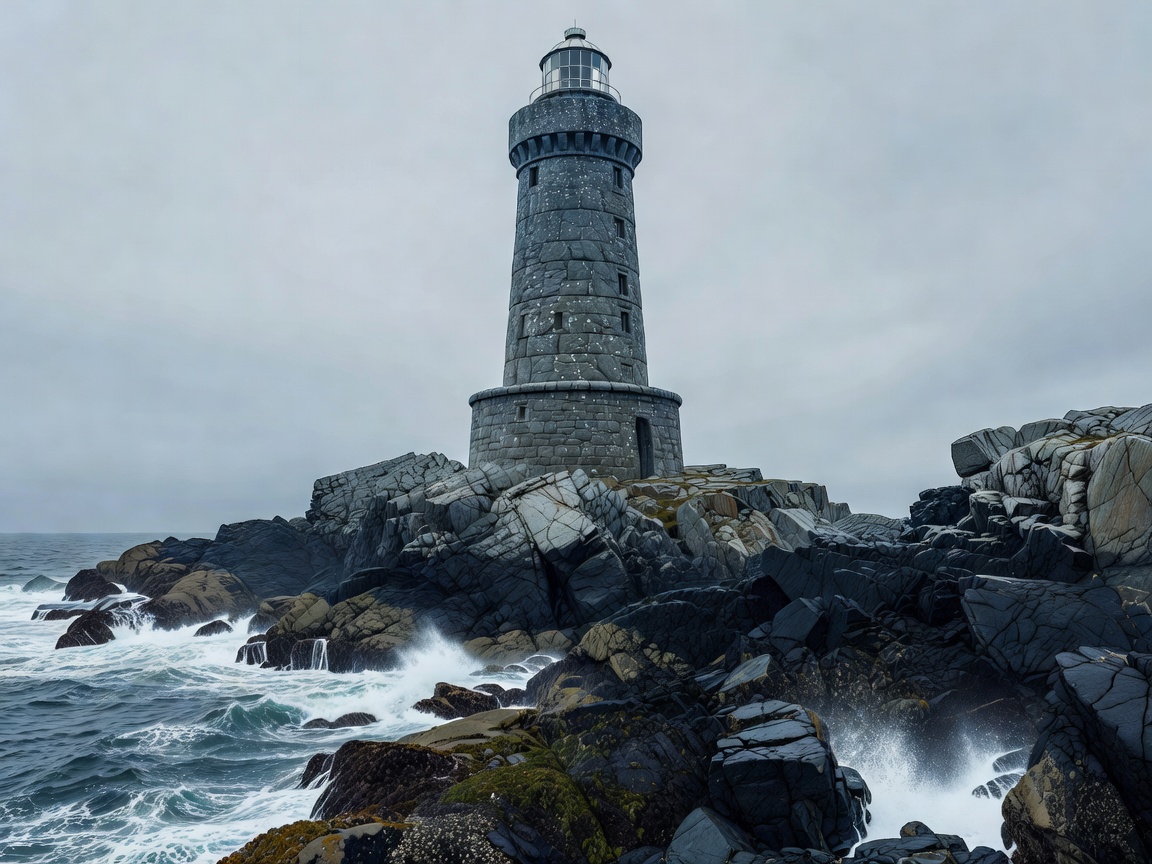
Why does Skerryvore look so tall?
Skerryvore’s visual effect comes from proportion. The shaft rises in a long taper above a wide granite base, making the lantern prominent against sea and sky. Height is useful because the curvature of the earth and local obstructions limit what can be seen from a vessel. Yet height costs material, increases wind loading and makes construction harder. The tower’s form is therefore a calculation in stone rather than a gesture towards grandeur.
Alan Stevenson used an established family of rock-tower ideas, but Skerryvore is not a copy of Bell Rock or Eddystone. The low, broken Torran rocks required a substantial foundation platform. The tower had to meet heavy seas while carrying its light high above them. Granite offered durability and mass, though quarrying, shaping and transporting it made the supply chain demanding.
What does granite change?
Granite is hard, durable and well suited to exposed masonry, but it does not become a lighthouse by being available. It must be quarried into manageable blocks, dressed accurately, numbered, moved and set in the right order. Offshore construction rewards repeatability. If a stone arrives with the wrong fit, the correction may not be a simple workshop adjustment; it may consume a rare working opportunity on the rock.
Interlocking masonry connects stones mechanically as well as through mortar. That approach matters where waves impose repeated shock and suction. The visible courses are not merely decorative stripes. They record an assembly method. A tower is strongest when the joint pattern avoids simple planes along which one zone could slide away from another.
How does the light apparatus fit the tower?
The lantern is the public-facing end of an internal chain. Historically, lamp, burner, fuel handling, clockwork where used, lenses and cleaning routines occupied different parts of the station. The optic gathers and directs light; the characteristic gives it a recognisable pattern. A powerful beam without a distinct published identity would be less useful in a crowded navigational picture.
As optical and power systems changed, the lantern’s purpose remained but its internal equipment changed substantially. Fresnel lens technology allowed light to be concentrated more efficiently than earlier arrangements. Electrification later altered the source and reduced some daily handling tasks. Modern remote operation replaces a resident presence with monitoring and planned intervention, but does not make the tower self-explanatory or maintenance-free.
| Choice | Trade-off |
|---|---|
| Tall lantern position | Greater visibility against greater structural demand |
| Granite masonry | Durability against difficult quarrying and dressing |
| Remote operation | Less routine residence against greater reliance on systems and access |
Who maintains this navigational role?
Skerryvore belongs within the Northern Lighthouse Board’s network. A general lighthouse authority does more than preserve historic structures. It manages aids to navigation as a coordinated service. A mariner reads a light alongside charts, notices, other lights, buoys and electronic aids. That context explains why a tower’s engineering, optic and characteristic cannot be treated as separate curiosities. They are parts of one signal, placed in one difficult piece of sea.