Why was Fastnet rebuilt?
The first Fastnet lighthouse used cast iron. Iron could be prefabricated and assembled, an attractive quality when the building site was a small offshore rock. But an exposed Atlantic location asks more than quick assembly. The structure must tolerate repeated wave attack, saltwater corrosion, vibration and the practical difficulty of repair. The later granite lighthouse answered with mass, interlocking stonework and a larger, more enduring presence.
The change illustrates a wider nineteenth-century pattern. Iron was valuable where transport and fabrication mattered. Masonry was attractive where permanence, weight and resistance to severe seas dominated. Neither material is automatically superior. The right choice depends on foundation shape, access, available workmanship, expected loads and the maintenance regime that follows.
Why are there two towers?
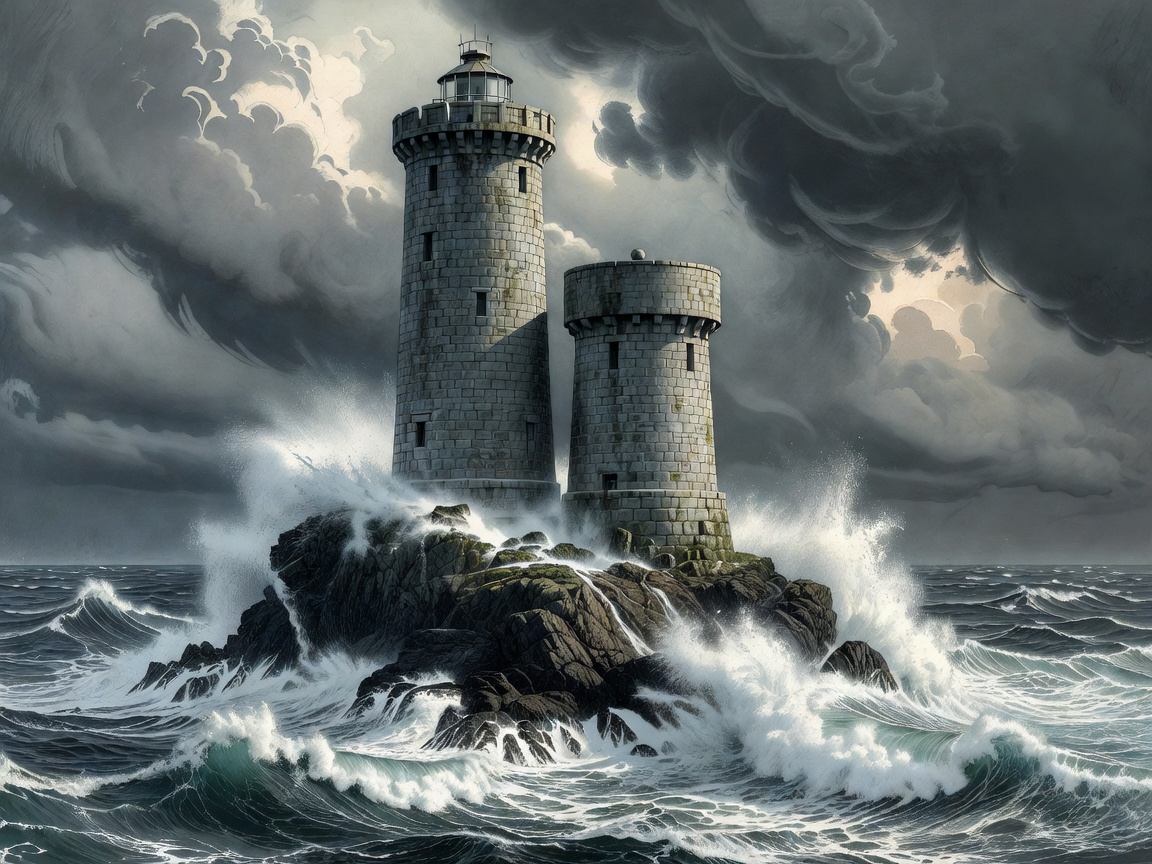
Fastnet’s granite lighthouse has a paired form. Two linked towers create more internal capacity and distribute functions across a broader footprint than a single slender shaft. A light station requires more than a lantern: stores, machinery, accommodation in the staffed period, access routes and structural circulation all compete for space. The twin arrangement also gives the silhouette a distinctive identity, useful in daylight recognition as well as structural planning.
A paired tower is not simply a decorative variation. It is a response to programme and rock. On a small foundation, designers must decide whether to pile functions vertically, spread them laterally, or combine both approaches. Greater width can offer stability and rooms, but it demands enough sound bearing surface. Greater height can lift the light, but increases the structure’s leverage against the base.
What does a light characteristic do?
At night, shape disappears. The navigator identifies Fastnet and other aids by their charted characteristics: the pattern of flashes, eclipses, colours or fixed light. The exact published description is a navigational datum and should be checked in current official publications, rather than inferred from a historic account. Characteristics prevent a coast becoming a row of anonymous bright points.
Optics make this possible. A lens system gathers light from a source and sends it in planned directions. Rotating or flashing mechanisms historically created sequences. Later electrical systems and electronic controls changed the machinery, but the requirement remained: produce a reliable signal that can be distinguished from neighbouring lights and ordinary shore illumination.
| Stage | Engineering emphasis |
|---|---|
| Cast-iron tower | Prefabrication and assembly on a remote rock |
| Granite paired tower | Mass, durability, capacity and exposed-site resilience |
| Automated light | Reliable operation without routine resident keepers |
What does automation mean at Fastnet?
Automation transferred routine watchkeeping away from the rock. It did not remove the Commissioners of Irish Lights from the equation. The authority’s task includes maintaining the aid’s place in a coherent network and arranging intervention when equipment or structure requires attention. Remote systems are especially valuable at hard-to-reach stations, but they make electrical supply, telemetry and fail-safe design central concerns.
Fastnet is therefore a useful bridge between eras. The granite speaks of masonry craft and resident station life. The operating model speaks of control rooms, scheduled maintenance and modern aids to navigation. Both belong to the same purpose: an unambiguous warning and reference point at a difficult edge of the sea.