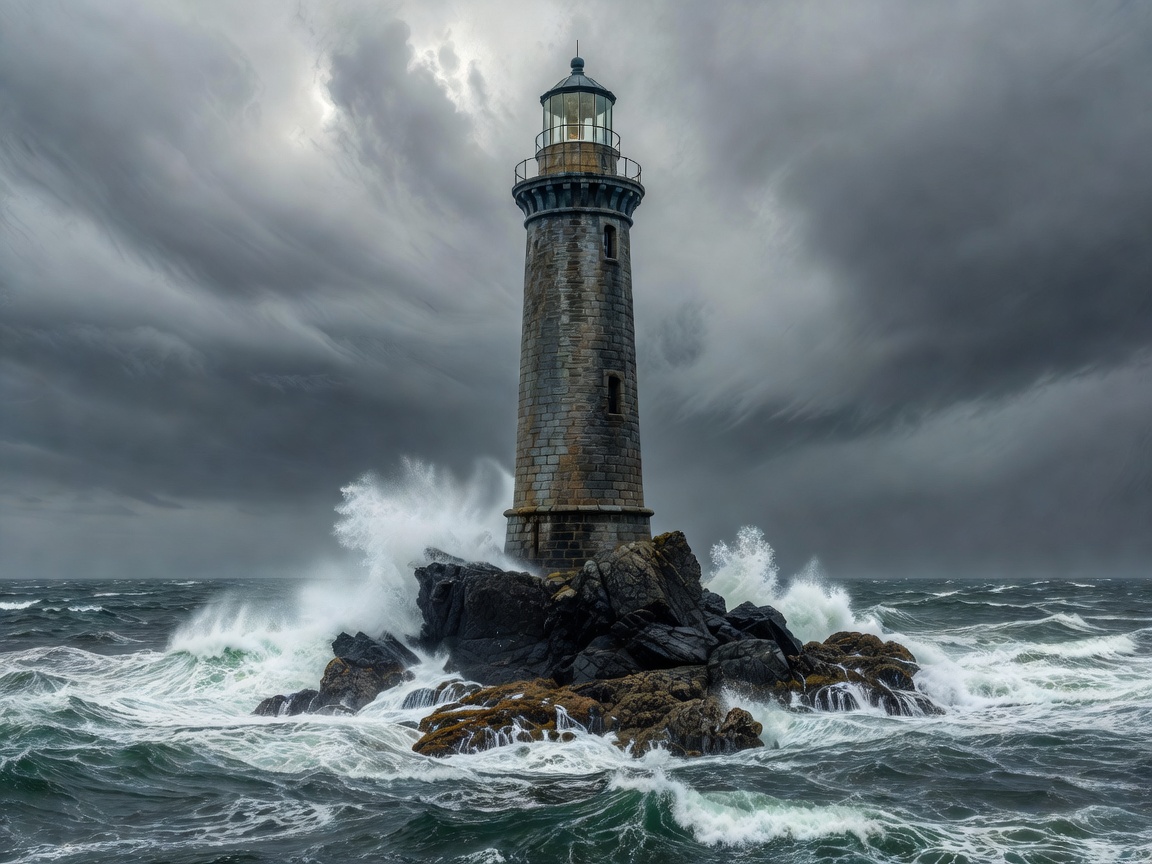
Why was Eddystone so difficult?
The reef gives little working area and is exposed to Atlantic swell. Construction could only proceed when tide and weather allowed men and materials onto the rock. A tower here must resist overturning, prevent joints from opening under repeated wave force, and keep its light high enough to be useful without making the structure top-heavy. Those demands pull against one another. More height improves range, but raises load and wind exposure.
Henry Winstanley’s early timber lighthouse was a bold response, but timber framing and elaborate upper work were poorly suited to extreme seas. It was lost in a storm. John Rudyerd then made a more compact timber tower, using a smoother taper. That too was eventually lost, this time to fire. The lesson was not simply “use stone”. Material, shape, connections and the placement of flame all had to work together.
What did Smeaton change?
John Smeaton’s eighteenth-century tower became the pivotal design. He chose granite and Portland stone, shaped the exterior with a swelling, curved profile, and made the masonry act as a single mass. Stones were cut with dovetail joints so that adjacent courses locked together. Hydraulic lime mortar mattered because it could set in damp conditions where ordinary lime mortar was unreliable.
The profile is often compared with an oak tree: broad at the foot, narrowing as it rises, with enough curve to direct some wave energy around the body. It is not an ornament. A straight-sided tower would offer a different balance of weight, surface and leverage. Smeaton’s form became influential because it made structural sense on a small rock.
| Design question | Eddystone response |
|---|---|
| Base connection | Interlocking masonry seated on prepared rock |
| Sea loading | Heavy tapered form and curved exterior |
| Fire risk | Later designs separated and improved light-room arrangements |
Why was the tower moved?
Smeaton’s tower itself was later removed because the underlying rock had deteriorated. The lighthouse did not fail merely because its walls were old; the foundation rock was the governing condition. Trinity House replaced it with a new tower on a stronger part of the reef. That distinction is useful in every lighthouse study. A sound superstructure cannot compensate indefinitely for an unsound bearing surface.
The old tower was re-erected on Plymouth Hoe as a memorial. Its relocation makes the design easy to inspect, but it also changes what the structure means. On land it demonstrates form and workmanship. On the reef it was part of a navigational machine: lantern, keepers’ rooms, stores, moorings, boats, weather and maintenance routes all depended on the site.
What does automation alter?
Automation changes occupation more than the fundamental engineering brief. A modern aid still needs a published light characteristic, an optical apparatus, reliable power and an authority able to inspect faults. The absence of resident keepers can reduce the need for domestic rooms, while increasing the importance of remote monitoring, access planning and robust equipment. At Eddystone, the long sequence makes that transition legible: the goal stays fixed, while the apparatus and working life around it change.