Eddystone: repeat building on an exposed reef
From Henry Winstanley’s timber experiment to John Smeaton’s interlocking stone, Eddystone shows why geometry and hydraulic lime mattered before a light could be trusted.
Open Eddystone notes →Coastal engineering notes
Britain and Ireland’s offshore lights are not one story. Eddystone changes its material language; Bell Rock makes a reef inhabitable long enough to build on it; Skerryvore stretches granite into a tall taper; Fastnet signals an Irish headland; South Stack works from a cliff edge.
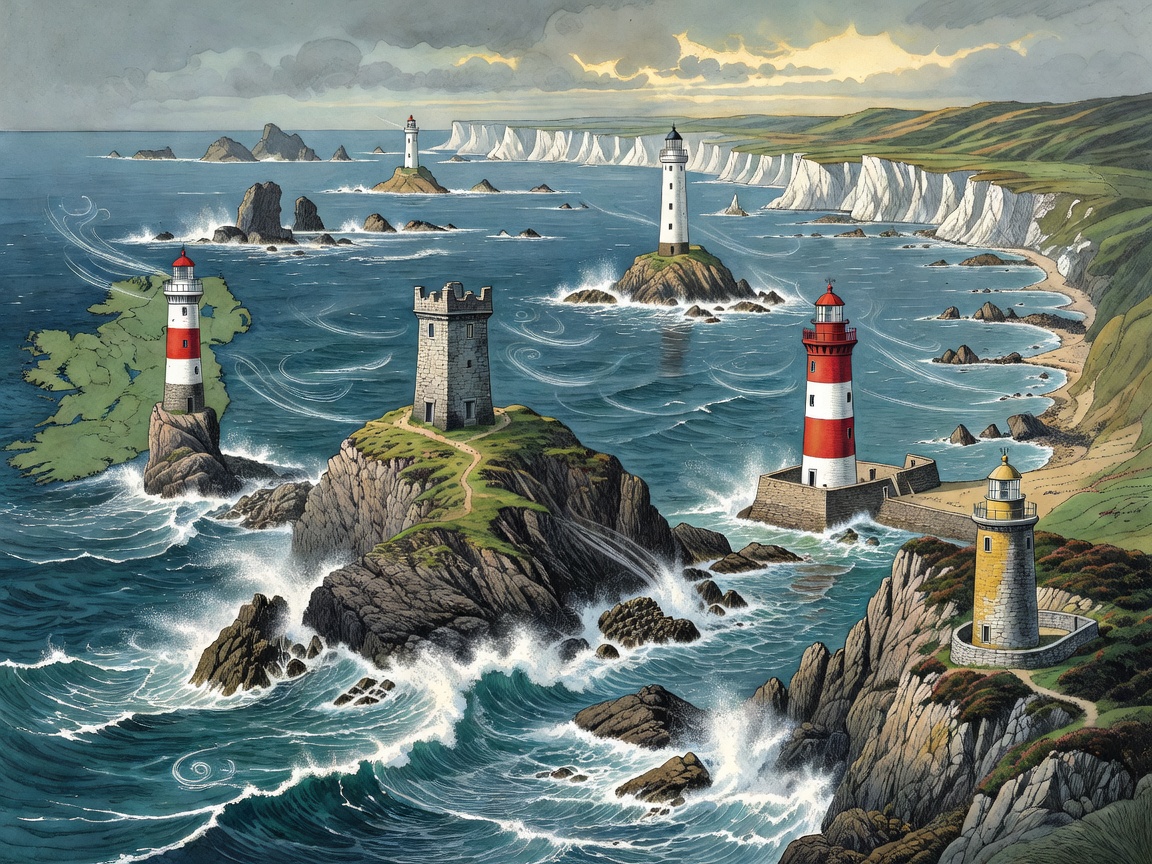
Five reference points
Each entry follows a different engineering problem and the body responsible for keeping the light useful to mariners.
From Henry Winstanley’s timber experiment to John Smeaton’s interlocking stone, Eddystone shows why geometry and hydraulic lime mattered before a light could be trusted.
Open Eddystone notes →Robert Stevenson’s tower stands on a reef covered by the sea at high water. Its construction camp, dovetailed masonry and light characteristic belong to one operational system.
Open Bell Rock notes →Skerryvore’s long granite shaft rises from the Torran rocks. The page considers the choice of profile, the difficult landing ground and the Northern Lighthouse Board’s role.
Open Skerryvore notes →The Fastnet story moves from cast iron to masonry and from staffed operation towards remote control, under the Commissioners of Irish Lights.
Open Fastnet notes →South Stack on Holy Island is a different proposition: access, fog signal history and a station set on rock rather than a tower founded offshore.
Open South Stack notes →Authority lines
Trinity House serves England, Wales and the Channel Islands. The Northern Lighthouse Board serves Scotland and the Isle of Man. The Commissioners of Irish Lights serves the island of Ireland. Their aids to navigation have shifted from resident keepers and local machinery towards monitoring, remote control and planned maintenance. Automation removes the need for routine residence; it does not remove the need for reliable power, optics, communications and access.