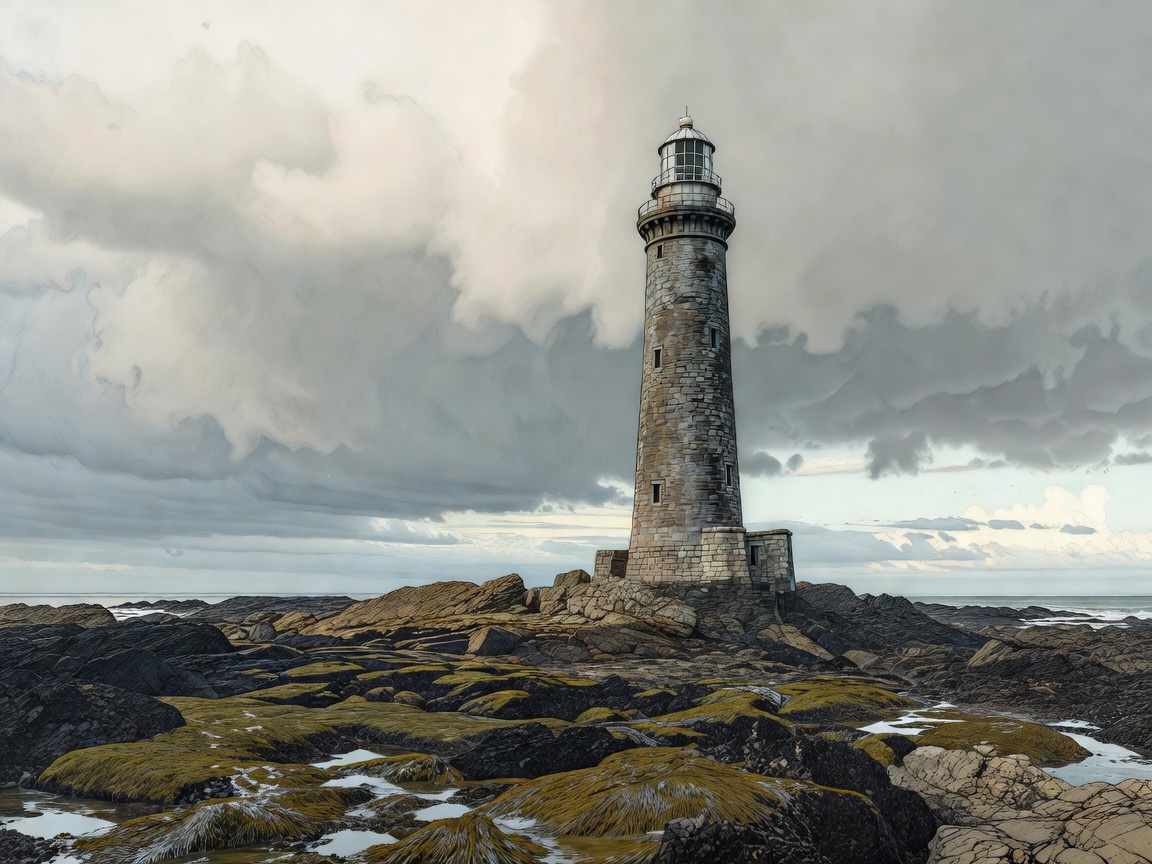
What makes a tidal reef different?
An offshore rock light is never simple, but Bell Rock adds a hard operational limit: the building platform lies under water for much of the day. Workers cannot merely arrive, unload and continue until dusk. Boats, men, tools and stone must meet the reef within short windows. The work therefore needed a shore base, floating accommodation and careful sequencing. A missed lift or damaged landing arrangement could cost more than an hour; it could interrupt a whole stage of work.
This is why accounts of Bell Rock pay attention to temporary works. The beacon and barrack arrangements were not incidental preliminaries. They created enough order for drilling, cutting the foundation bed and laying stone. A permanent tower begins with temporary structures that can survive long enough to be useful, then yield place to the finished fabric.
How does the masonry hold together?
Bell Rock follows the established model of a tapered masonry tower, but its details answer the reef’s particular constraints. The lower stones were shaped to fit the prepared sandstone. Courses were connected by dovetailing, a method that resists relative movement between blocks. Heavy granite and sandstone made a dense shell. The base is broad; the shaft narrows. This keeps mass where wave action is strongest and reduces the lever arm higher up.
There is a trade-off in every such form. Very large blocks improve mass and continuity, yet are harder to land accurately in a short tidal period. Fine joints improve fit, yet demand skilled cutting and checking. The solution is not a single feature called “strength”. It is a chain: survey, rock preparation, lifting, jointing, mortar, curing and protection of the unfinished work between tides.
Why is the station more than the tower?
A lighthouse has often been described by its silhouette, but mariners depend on a system. The lantern must produce an identifiable light characteristic. Fuel or electrical supply must reach the apparatus. The optic needs cleaning and maintenance. A fog signal, where provided, has its own machinery and acoustic requirements. Keepers historically managed all of this while living in a space constrained by the tower’s structure.
Bell Rock’s staffed era makes the connection visible. Domestic rooms sit above the wave-resisting base; the lantern sits above the living and service levels. The vertical order is functional. Low levels prioritise strength and storage. Higher levels provide accommodation and access to the light. A shore facility extends the same system beyond the reef.
| Element | Reason for it |
|---|---|
| Temporary beacon | Marks the reef during construction and supports work organisation |
| Tapered tower | Places structural mass low down and reduces upper exposure |
| Interlocking stone | Helps masonry behave as one connected body |
What remains after automation?
Automation ends the routine residential pattern, not the coastal obligation. The Northern Lighthouse Board still requires equipment that can be maintained safely and a signal that fits the wider charted network. Remote monitoring can report faults quickly, but it depends on resilient communications and power. The old rhythm of keepers’ watches becomes a maintenance and control rhythm. The reef remains exactly where it was. That is the stubborn part of the brief.